


This article is an introduction to my upcoming piece in Sword&Spade: “Your Death Will Be Weird.” Please subscribe to their excellent magazine here.
The autumn wind carries a chill like the breath of an open grave. Leaves turn, revealing their skeletons and shriveled flesh. The ground is hard and gold-baked from the punishing sun of August, and yet each morning brings banks of fog and dew from the North, silently billowing over lawn and roof and tree. The mist muffles the rustle of leaves while I walk to school, and the dawn coming later each day means that the mornings are increasingly silver-blue and silent.
Michaelmas felt like a door to autumn; the golden fatness of pecans starting to turn, the heat-baked smells of hay, harvest in the heat and the coolness of lemonade in the shade. Now I watch the first blue norther come in from my porch, smell the petrichor and hear the murmuring trees creak their branches. Now—as we enter the Hallowtide Triduum—something more final has breathed across the land.
It is Death.
On the coming of Fall, it is fitting to meditate upon death. The ancient pagans knew that this was a time of thinness, where the veil between life and death was gauze-scant. And they feared the dead. The Church, which baptizes all things good and true and beautiful, and re-orients them to God, took this awareness and the traditions that surrounded it and married them to Allhallowtide. The Natural, Agricultural, Psychological, and Cultural were married to and perfected in the Liturgical, which above all, turned the fear of death and demons, veils torn and veils thin, into a triumphant Hope. Death and Haunts aren’t what they used to be; in Christ (Firstborn of the Dead, not a Ghost but Flesh) Death is a door and Spirits are souls.
It is fitting indeed. We meditate upon death, and how it is no longer the End. We pray for the souls of the Church Penitent, undergoing the sanctification in Purgatory. We pray with the Church Triumphant, worshipping and interceding for us before the very throne of the Father. And we pray as the Church Militant, who fights here on Earth, armed to the teeth against the powers of darkness.
There’s a dignity and a triumph in Hallowtide, despite the quiet presence of Death… or rather, because of the presence of Death.
But if you’re anything like me right now, you’re probably not feeling particularly inspired by the season. It’s hard to celebrate the Church Triumphant when we feel so… defeated.
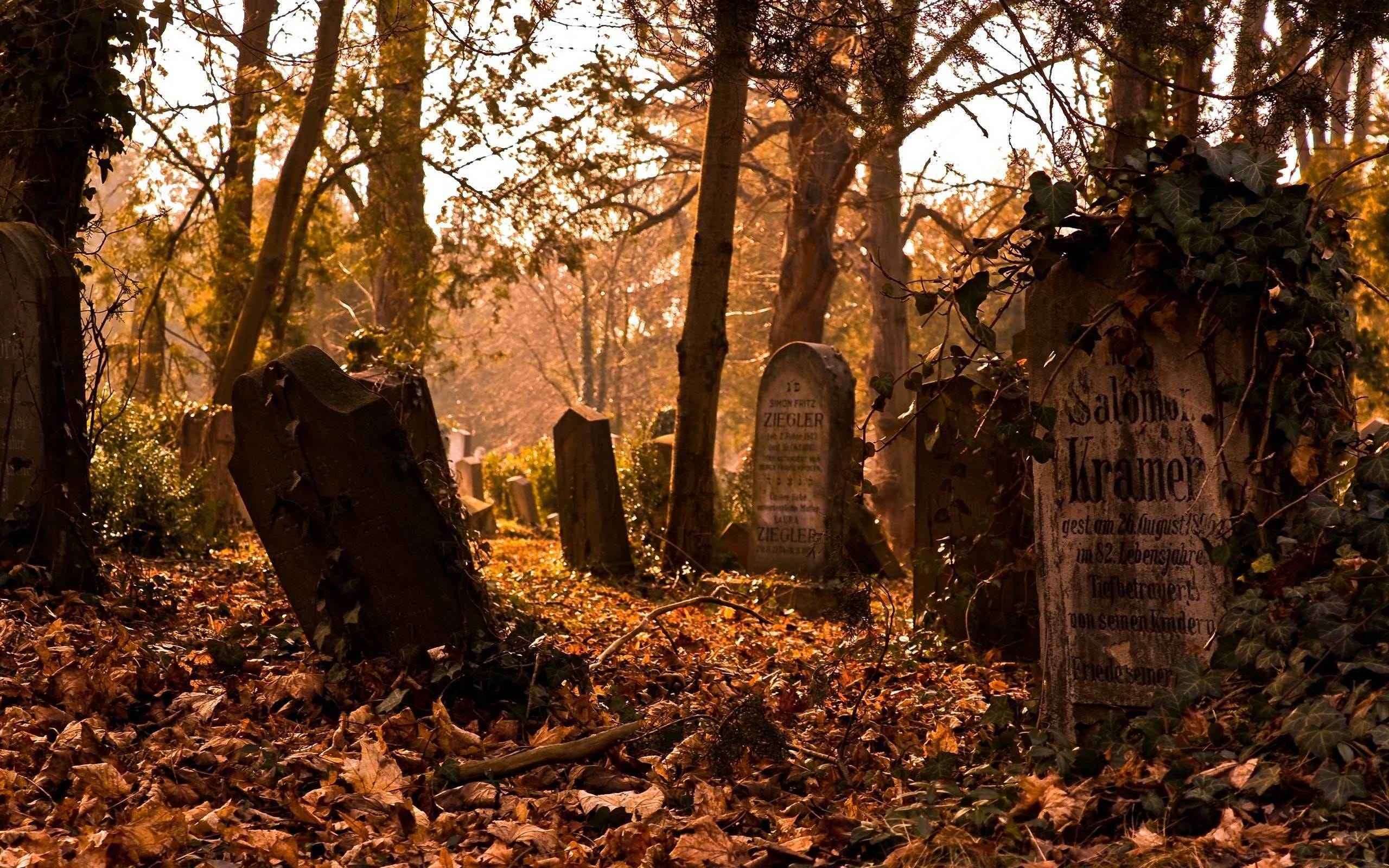
It is popular nowadays to talk about society rising and falling in mechanical cycles, or, like a clock, swinging back and forth like a pendulum. Civilization is either “running” or “operating” like a machine. We treat our bodies and families the same; like machines with parts that are either “functioning” or “dysfunctional.” But these metaphors are too clean for an organism; and I have found it remarkably clarifying to remember that we used to speak not of operation, but of health; not of cycles, but of seasons.
The difference seems slight (isn’t a season a cycle?), but different language connotes different attitudes. Mechanical metaphors are sterile, inevitable. Replaceable. They deny the possibility of resurrection. But understanding our times through more organic language tastes different on our tongues. The crises we see in the Church and in the world are suddenly shifted; not cast as mechanical failure, but as a decay that already has within it the promise of new life, of Spring. Machines never rest until they are broken, but land and farms and gardens die to sleep.
The Church’s “cycles” are not a machine that grinds to a halt, cannibalized for some new operating system. It’s not even a failure. It is, rather, a kind of autumn. A kind of Death. Not decline, but Fall.
In this light, the Fall of the Roman Empire becomes a rather funny pun. The Roman empire did not disappear, but rather waned, so that a new season could begin. O Happy Fall, that won for us so great a Savior. Empires may crumble into ruin but they are not discarded; they break down into the soil for the next harvest of souls.
If the decline of the Roman Empire was its autumn, the Winter was what popular culture has named “The Dark Ages.” And its Spring was the Birth of Christendom. Its Harvest was the High Middle Ages.
But then the land, rather than being prepared for a new Spring, was uprooted. I don’t think it is a coincidence that the “scientific revolution” conceived of the cosmos as a clock rather than a Garden. A clock is a mechanism, and it can be controlled and constructed. A garden, on the other hand, must be tended and kept. It was a fundamental category error; and the symbolic distortion became a sort of cosmological disinheritance. The land and culture received by the Enlightenment, previously an ecosystem, was shattered into parts and resources. Instead of growing and tending, we got into the business of constructing, inventing, modifying. A new kind of thing was born and its extraordinary success gave it a frenetic optimism and energy—the energy of the engine as opposed to the flower.
A society built on the model of a machine can break, and ours seems to be breaking. Winding down like a rusted clock. A society aligned with seasons, on the other hand, can accept its death with hope, even as we mourn—because we know that every leaf that falls is next year’s soil.
The Church is a society grown this way. And although we have caught the virus of mechanistic thinking (and exhibited symptoms), the Body of Christ is not an engine, doomed to catastrophic failure.
But it can Die Back. This is not reason for panic, but rather for somber prudence—and careful planning for next year’s crop. We have hope even in the midst of mourning, because—like Christ Himself—the Church is not in the business of Reconstruction, but in the business of Resurrection. The seeds are scattered and buried, but the Gardener has done His work, despite the weeds and chemicals, the broken-down tractors and piles of garbage left by poor stewards.
And I, too, begin to recognize that every time I die to myself, a new thing is seeded in me and grows, animated by viriditas, ready to blossom and fruit in its season. I die to sleep, not to shatter. I die back, not die off.
In Autumn, we see the signs of death everywhere. The land whispers it. The sun begins to hide his face. The air itself carries its pallor. And yet, and yet. A wise farmer knows that the death is right and good and necessary.
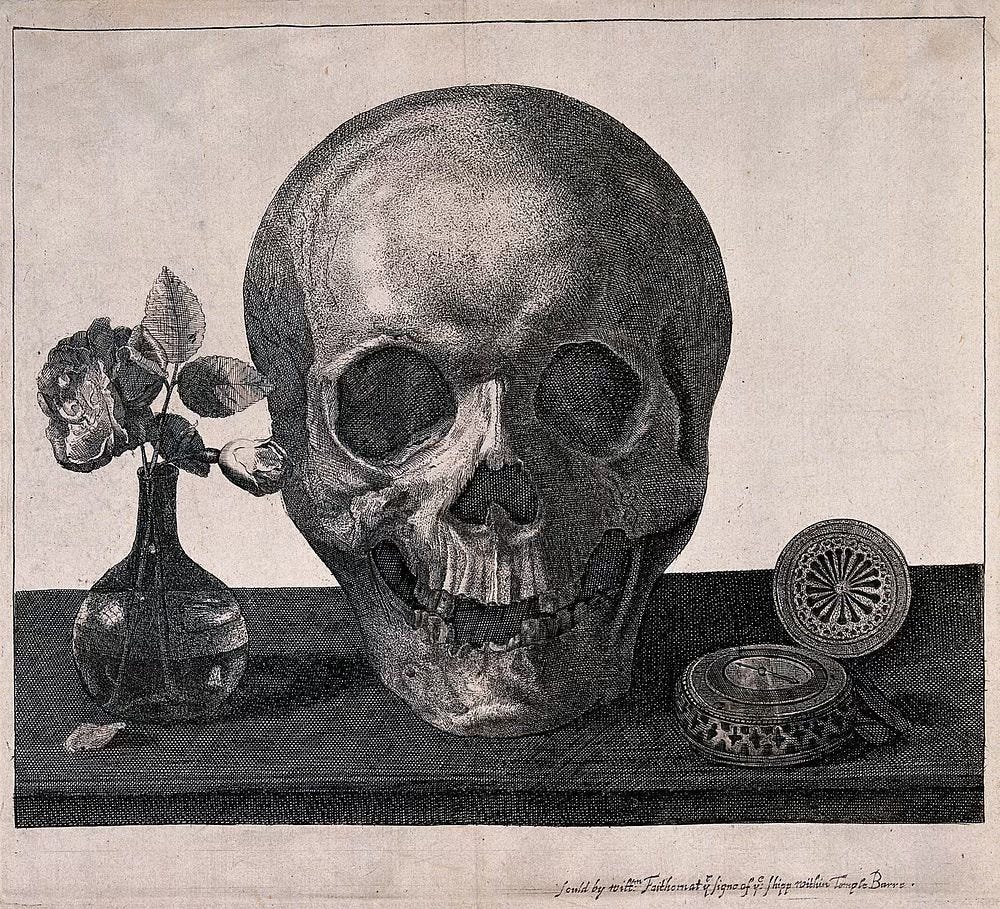
Our skulls grin.
Because Death, to the Christian, is a brother to Hope.
To read my article on the meaning of Death, please consider subscribing to Sword&Spade Magazine.